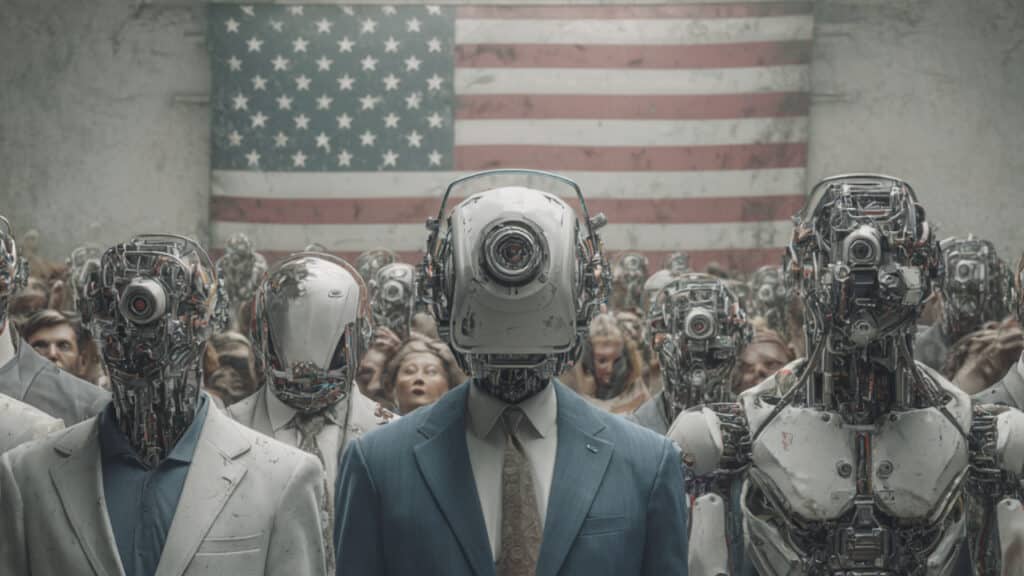
What if Bernie Sanders is right, and Jay Powell is wrong?
What if the AI revolution causes mass layoffs of American workers, as the Vermont senator predicted in a recent op-ed published by Fox News? And what if Fed Chair Jay Powell is wrong that the softening labor market is due primarily to supply issues – lower immigration and a lower labor participation rate – rather than AI-produced “efficiencies?
What will be the response of policymakers? What should be the response of policymakers?
For sure, AI will soon become a political battleground. Democratic Socialist Sanders, ever the class warrior, has already questioned whether AI will be helpful to all Americans or only to “a handful of billionaires.” Like the trade deals that sent millions of jobs overseas, Sanders worries that the massive investment flowing into AI will result in as many as 100 million workers losing their jobs over the next ten years. He could be right; imagine the repercussions.
Young people are already losing faith in capitalism and cozying up to Socialism. Two-thirds of all Democrats view socialism more positively than capitalism. Nothing could undermine our capitalist system faster than wide-spread job losses stemming from a tech breakthrough cheered by the investor class.
This is the critical issue of our day, and one that is getting scant attention, even from the likes of self-described “data-driven” Powell, who is perennially looking backwards rather than forwards. In his latest press conference. Powell answered one question about employment by saying, “the supply of workers has dropped very, very sharply due to mainly immigration, but also lower labor force participation. So, and that means there’s less need for new jobs, because there’s — there isn’t this flow into the pool of labor where people need jobs.” Um, what?
The economy is growing, and yet hiring is declining. Though the government shutdown has blocked the usual monthly labor reports, plenty of data suggests that the job market is weakening. Companies are increasingly citing AI investment as leading to lower headcounts.
Corporate America is spending tens of billions of dollars on AI, promising shareholders great gains in productivity; where will that productivity come from other than reducing headcounts? Certainly, people armed with artificial intelligence can deliver information and analyses more rapidly; that will make them and their organizations more productive. But ultimately it will also make some people redundant and stunt hiring. The impact on America’s labor market will be profound and is largely being ignored.
Amazon recently announced that it was firing 14,000 people; a top human resources official at the firm sent a note to employees titled “Staying nimble and continuing to strengthen our organizations.” She wrote “that the world is changing quickly. This generation of AI is the most transformative technology we’ve seen since the Internet, and it’s enabling companies to innovate much faster than ever before…”
What kinds of workers are at risk? Factory workers and truck drivers, for sure, who are already being replaced by robots and AI, but also white-collar employees. Fortune writes that the Amazon layoffs “show it’s coming for middle management first.” Note that the world’s largest retailer employs some 1.5 million people; 14,000 is a drop in the bucket. But the trend is worrisome, and for those 14,000 people, devastating.
Amazon is not alone. UPS recently announced it has cut 48,000 jobs this year, of which 14,000 were management positions and 34,000 from operations. UPS started the year with about 500,000 employees. Target, too, made headlines recently, saying it will cut 8% of its corporate workforce. It was the first significant layoffs made by the retailer in a decade.
Outplacement firm Challenger, Gray and Christmas cites market and economic conditions as the reason for most of the corporate layoffs to date, but also points to AI. The AI impact makes sense. After all, the economy is growing briskly; second-quarter real GDP growth was 3.8% and it looks like we will see robust expansion for the third quarter as well.
There has never been a faster pick-up of a new technology. Already an estimated one third of Americans are using AI; ChatGPT receives 5.4 billion visits per month. Global revenues from AI are expected to total $391 billion this year and are projected to reach $3.5 trillion by 2033. These estimates could be too optimistic, but top tech firms are investing some $400 billion into building out their capacity just this year, according to the Wall Street Journal. They believe those projections.
Bernie Sanders aside, no one should want to impede the AI revolution. Artificial intelligence will allow for extraordinary progress in medicine and other sciences, and it could radically improve the education of America’s children.
Also, it is largely American companies that will benefit from the explosion in AI spending, producing the profits and benefits that come from global dominance of a new technology. Rising productivity will lead to hiring in specific industries and real wage gains. It will also allow for the retirement of the 20+ million Boomers still working.
But there may well be a period of adjustment, where layoffs exceed the jobs created. Unemployment may rise, bringing anger at the innovations producing more out-of-work Americans and fury at the companies behind the technology-driven disruptions.
Legislators and our banking officials need to be prepared for this possibility, which could further voters’ increasing affection for socialism and rejection of capitalism. That would be a disaster for our country, which has out-grown and out-performed every other nation on earth, producing unprecedented opportunities and wealth.
Otherwise, it will be Bernie Sanders and his left-wing colleagues who will dictate the response. Sanders advocates moving to a 32-hour workweek with no loss in pay, giving significantly more power to workers, and placing a “robot tax” on big tech companies. Such measures would slow American competitiveness and growth, as it has in Europe.
We cannot allow that to happen.
This article originally appeared on FoxNews.com
